6 Benefits of Rep Ranges & RIR Over Fixed Rep Targets
TOPIC: Coach Development | Sports Performance
There’s nothing wrong with prescribing 3×10, but those numbers don’t tell you how hard your athlete actually worked or how much they had left in the tank. Here are six ways using rep ranges and RIR can make your programming more flexible, intentional, and effective while helping athletes better understand their own effort.

Written By
BRYAN BOORSTEIN
With more than 28 years of training experience and 17 years of coaching, Bryan Boorstein is the co-founder of Paragon Training Methods and former owner of CrossFit Pacific Beach. A three-time CrossFit Regional athlete and former physique competitor, Bryan has also coached athletes at the CrossFit Games. He holds a bachelor’s degree in exercise physiology and sports management, with additional education through CrossFit, OPEX and N1 Training. He also co-hosts the Eat Train Prosper podcast.
For decades, resistance training programs have been written with prescriptions such as 3 sets of 10 reps. This is simple, easy to understand, and there’s nothing inherently wrong with it.
But there’s also a lot that 3×10 doesn’t tell us.
Imagine two athletes performing 3 sets of 10 on the same exercise. With no other information, one athlete may finish every set and could have performed another 5 reps. The other athlete may barely complete the final rep of each set—taking each set to failure.
On paper, they performed the exact same workout, but without an “effort” prescription, they were physiologically very different sets.
What are reps in reserve?
Reps in reserve, or RIR, measures how many more reps you could do in a set while still maintaining good form. In other words, how close you are to reaching failure. If you do 10 reps and know you could do four more without sacrificing form, you’d have an RIR of 4 for that set.
One of the primary reasons I’ve become such a big proponent of using RIR or rate of perceived exertion (RPE) in my programs is because if you combine an “effort” prescription like RPE with the use of rep ranges (instead of static rep targets), the training program improves dramatically.
Instead of 3×10, I might prescribe 3 sets of 8-12 reps @ 1-2 RIR
At first glance, the second prescription looks less precise. I’ve given the athlete five different possible rep targets instead of one. In practice, however, I provided considerably more information about how I want the sets performed.
And perhaps more importantly, I’ve asked the athlete to develop one of the most valuable skills they can have in the gym: self-awareness of effort.

6 benefits of using RIR and rep ranges
1. It helps athletes manage fatigue
There is actually nothing wrong with 3×10 (especially if it has an effort prescription). Fixed rep prescriptions have been used successfully for decades, and there are plenty of situations where I still use them (I discuss these more near the end of the article).
The problem is that “10 reps” doesn’t tell us everything we could know about the set.
As fatigue accumulates, the same load and same number of reps naturally become more difficult.
Again, there’s nothing wrong with this approach. In fact, that increasing effort across sets may be exactly what the program intends.
But compare that with a prescription of 3 sets of 8-12 reps @ 1-2 RIR.
Now the athlete has a different objective. Instead of forcing every set to stop at 10 reps, they’re trying to perform as many quality reps as they can while maintaining approximately 1-2 reps in reserve (1-2 reps from failure).
Their completed workout might look like:
Set 1: 12 reps @ 1-2 RIR
Set 2: 10 reps @ 1-2 RIR
Set 3: 9 reps @ 1-2 RIR
The rep count changed, but the intended effort remained relatively consistent. Physiologically, that’s the signal that will help the athlete manage fatigue and build self-awareness to progress methodically over time.
2. It teaches athletes to become active participants in training
A fixed rep target primarily tells you how many reps to perform. A rep range combined with RIR tells you how hard I want you to work. Rep ranges require the athlete to think.
This might be my favorite aspect of using rep ranges.
When an athlete sees “3×10,” there’s a temptation to shut the brain off and complete the assignment—do 10 reps, no matter how hard, then rack the weight.
But when the prescription says 8-12 reps @ 1-2 RIR, the athlete must continuously assess what’s happening.
Could I perform another rep? Could I perform 2? Is my technique beginning to change? Was that actually 2 RIR, or was it closer to 4? Should I increase the load next set? Should I decrease it?
This process requires the athlete to become an active participant in their training rather than simply executing numbers on a spreadsheet.
And like any other skill, the ability to assess effort improves through practice. Nobody begins training with a perfectly calibrated internal RIR gauge. That’s okay. The point is to begin developing one.
Eventually, the athlete isn’t simply getting stronger; they’re getting better at training themselves and managing a series of variables that improve their knowledge over time.
3. It accounts for normal fluctuations in performance readiness
“Daily Preparedness” is a catchy phrase that elucidates how human performance isn’t static.
Your ability to perform a particular exercise can fluctuate based on: sleep, nutrition, stress, accumulated training fatigue, exercise order, and dozens of other variables.
Maybe last week you performed 100 pounds for 10 reps at 2 RIR. This week, 100 pounds might get you 12; or it might get you 8. Neither outcome necessarily means your program is working perfectly or failing miserably.
A rep range gives us room for those normal fluctuations without abandoning the intent of the program.
If the prescription is 8-12 reps @ 1-2 RIR, you have freedom to navigate the range based on how prepared you are for that day, and how that readiness may impact your performance.
The important question becomes: Did you select an appropriate load and finish the set at approximately the prescribed level of effort? This is autoregulation within a structured program.
4. It supports progression while protecting technique
In many of my programs, proximity to failure is a progression variable itself, such that we are progressing effort across the cycle within a rep range.
For example, let’s look at a heavier lower-body compound exercise, such as an RDL or squat-pattern movement.
I might begin a six-week cycle relatively conservatively and intentionally increase effort as the cycle progresses. This allows the athlete to dial in technique and build confidence in the movement in the earlier weeks, then push the intensity toward the end of the cycle.
Reps in reserve example workout calendar
Week 1 (Introduction week)
Set 1: 5-8 reps @ 4-5 RIR
Set 2: 8-12 reps @ 3-4 RIR
Week 2
Set 1: 5-8 reps @ 3-4 RIR
Set 2: 8-12 reps @ 3 RIR
Week 3
Set 1: 5-8 reps @ 2-3 RIR
Set 2: 8-12 reps @ 2 RIR
That process continues until the final week, where the heavier set might reach approximately 1 RIR and the lighter set reaches 0 RIR.
Now the athlete can autoregulate and have access to multiple forms of progression occurring simultaneously.
The athlete may add load and keep the reps similar. They may perform more reps at the same load.
The beauty of this approach is that each week feels like a small win.
The athlete can leave the workout feeling like they didn’t just spin their wheels and do the same thing as the last week. When we look at the enjoyment and consistency around training, this has been one of the main testimonials we receive.
On other exercises that are less physically demanding than RDLs and squats, the final week(s) of the cycle might even include partial reps, a rest-pause technique, or another intensity technique after reaching failure.
The important point is that effort itself can be programmed and progressed. A rep range makes that much easier to execute.
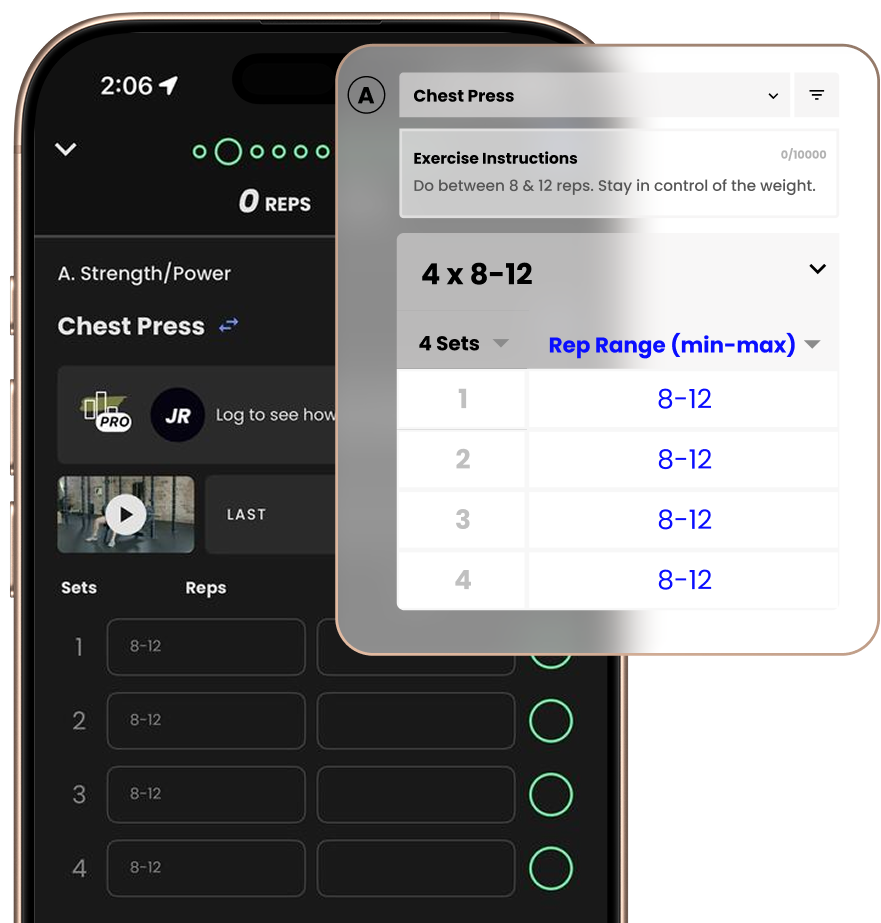
Coaching Tip → With TrainHeroic’s Rep Ranges feature, you can prescribe flexible rep targets and use athlete’s logged reps to manipulate future prescriptions.
5. It makes it easier to track progression
Another valuable benefit of progressing RIR within the rep range across a training cycle: The final weeks give us a much clearer assessment of whether we’ve actually progressed.
RIR is inherently an estimate—but luckily, we don’t need perfect RIR accuracy in those early weeks for this model to work.
Let’s say an athlete accidentally sandbags Week 1. They perform 10 reps at what they report as 4 RIR, but in reality they probably had 6 reps left.
As the cycle progresses, and the athlete continues working closer to failure, there is less room for ambiguity. By the time we reach that final 0-1 RIR week, we’re essentially conducting a performance test within the normal structure of the program.
If you performed 8 reps with 100 pounds at 0-1 RIR, there’s considerably less guesswork involved. You were either at failure or very close to it. Now we have a benchmark.
Your RIR progress won’t disappear between cycles
Even if the next training cycle begins with intentionally conservative RIR targets (meaning you lower the weight or rep targets), that’s fine, because we’re accumulating quality training while managing fatigue and gradually increasing effort until we can once again test and assess progress.
When we eventually return to that 0-1 RIR week, we can compare apples to apples. Maybe that 100 pounds for 8 reps at 0-1 RIR is now 105 pounds.
Now we have much stronger evidence that we’ve actually progressed.
I don’t get overly concerned if an athlete’s RIR estimates aren’t perfectly calibrated in the early weeks of a cycle. Those weeks still serve an important purpose, and learning to estimate RIR is part of the process.
But the progression toward failure eventually creates its own reality check. You can accidentally sandbag 4 RIR. It’s a lot harder to accidentally sandbag 0 RIR.
And once you’ve established that end-of-cycle performance benchmark, you have something concrete to beat the next time around.
In that sense, the final week isn’t just the hardest week of the cycle—it’s where the progression model gets to prove whether it worked.
6. It provides better data for programming decisions
If an athlete reports that they completed 10-10-10 reps over 3 sets, what does that actually tell us?
Now imagine I prescribe 3×8-12 @ 1-2 RIR and the athlete reports 12-11-9 reps.
Over time, I can see how the athlete responds to different exercises, loads, rep ranges, and levels of effort. That information helps me make better programming decisions. The athlete becomes better at interpreting the way their body responds to a prescription, and the coach becomes better at interpreting the athlete(s).
When fixed reps are better than rep ranges
None of this means fixed reps should disappear from training programs. I still use them.
Here are three instances where I choose fixed reps over rep ranges:
1. When the goal isn’t to maximize an individual set, but rather to create a stimulus systemically.
My favorite way to use static rep targets for hypertrophy is through “short-rest” set work, which floods the muscles with a ton of stimulus (via numerous effective sets close to failure) in a short period of time.
Example chess press workout:
- Select approx. 15-rep max weight
- Complete sets of 8 reps until you fail to make 8 reps unbroken
- Rest only 45 seconds between sets
This sequence provides insight into how well the athlete clears metabolites, which can then dictate programming decisions. Over my 28+ years training, I’ve seen people achieve over eight sets on this protocol, and others achieve only three. This is valuable insight!
2. When load, technique, and fatigue management outweigh athlete autoregulation.
On heavy compound lifts, I may prescribe static targets like sets of 3. However, I will always give an “effort” qualifier first, such as “6 sets of 3 reps with an 8-rep max weight.”
I know that the first set will be around 5 RIR, and I would expect effort to increase slightly across the sets. (Unlike hypertrophy, strength work doesn’t require us to work as close to failure to achieve the maximal benefits.)
3. When standardizing baseline performance across sessions.
Fixed reps are essential when we’re trying to standardize performance from session to session, or when a progression model is built around a specific number of repetitions.
The question is not: Are fixed reps good or bad?
The better question is: What information am I trying to communicate with this prescription?
Sometimes “perform 8 reps” is exactly the information the athlete needs.
But when effort and proximity to failure are important components of the training stimulus, I generally want the prescription to communicate those things too.

Add RIR and rep ranges into your athletes’ training programs
This brings us back to the strange paradox we started with:
3×10 looks precise. 3×8-12 @ 1-2 RIR looks flexible.
But in many contexts, the second prescription tells us much more precisely what we’re trying to achieve.
I’m not particularly concerned whether my athlete performed nine reps or 11. I’m much more focused on whether they selected an appropriate load, executed high-quality reps, and reached the intended proximity to failure.
And over time, I want my athletes to become increasingly capable of making those assessments themselves. Rep ranges are one of the simplest tools we have to facilitate that process.
They allow us to manipulate not only load and repetitions, but effort itself across a training cycle.
And eventually, when those RIR targets reach 0-1, the athlete gets the opportunity to truly test their performance. This gives us an objective-enough benchmark to determine whether all of that training actually produced progress.
Find Your Perfect Training Plan
Sometimes all you need to reach your destination on your fitness journey is an expert guide. Look no further, we've got you covered. Browse from thousands of programs for any goal and every type of athlete.
Try any programming subscription FREE for 7 days!
Related Articles
You May Also Like...

5 Ways to Drive Athlete Engagement
Whether you’re transitioning from in-person to remote coaching or setting new goals for your online coaching business, keeping clients engaged will be your line to success. Above your expert programming, it’s your coaching efforts – inspiration, motivation, and...

How Coaches Can Use Technology to Build a High-Performance Culture
Coaches love to talk about culture, but talking about it and building it are two very different things. A strong culture doesn’t happen because you add software, post a slogan, or expect athletes to magically buy in. It happens when your values, expectations, and...

The Best Suggested Swaps for 6 Common Exercises
You’ve programmed the perfect session… only for your athlete to DM you five minutes before training: “Hey coach, the squat racks are all taken.” “My gym doesn’t have that piece of equipment.” “My knee is feeling a little spicy today.” Exercise swaps are a normal part...
5 Ways to Drive Athlete Engagement
Whether you’re transitioning from in-person to remote coaching or setting new goals for your online coaching business, keeping clients engaged will be your line to success. Above your expert programming, it’s your coaching efforts – inspiration, motivation, and...
How Coaches Can Use Technology to Build a High-Performance Culture
Coaches love to talk about culture, but talking about it and building it are two very different things. A strong culture doesn’t happen because you add software, post a slogan, or expect athletes to magically buy in. It happens when your values, expectations, and...

Want more training content?
Subscribe



For Coaches
For Athletes
About
Support
Training Lab
Access the latest articles, reviews, and case studies from the top strength and conditioning minds in the TH Training Lab!
Made with love, sweat, protein isolate and hard work in Denver, CO
© 2026 TrainHeroic, Inc. All rights reserved.